When most people picture a pharmacy technician, they picture someone standing behind the counter at a retail pharmacy.
They imagine ringing up prescriptions, answering customer questions, and working in a busy store.
That is definitely one version of the job, but it isn’t the only one.
Some pharmacy technicians work in hospitals, long-term care facilities, specialty pharmacies, and healthcare systems. Their work looks very different from what you might see in a retail pharmacy.
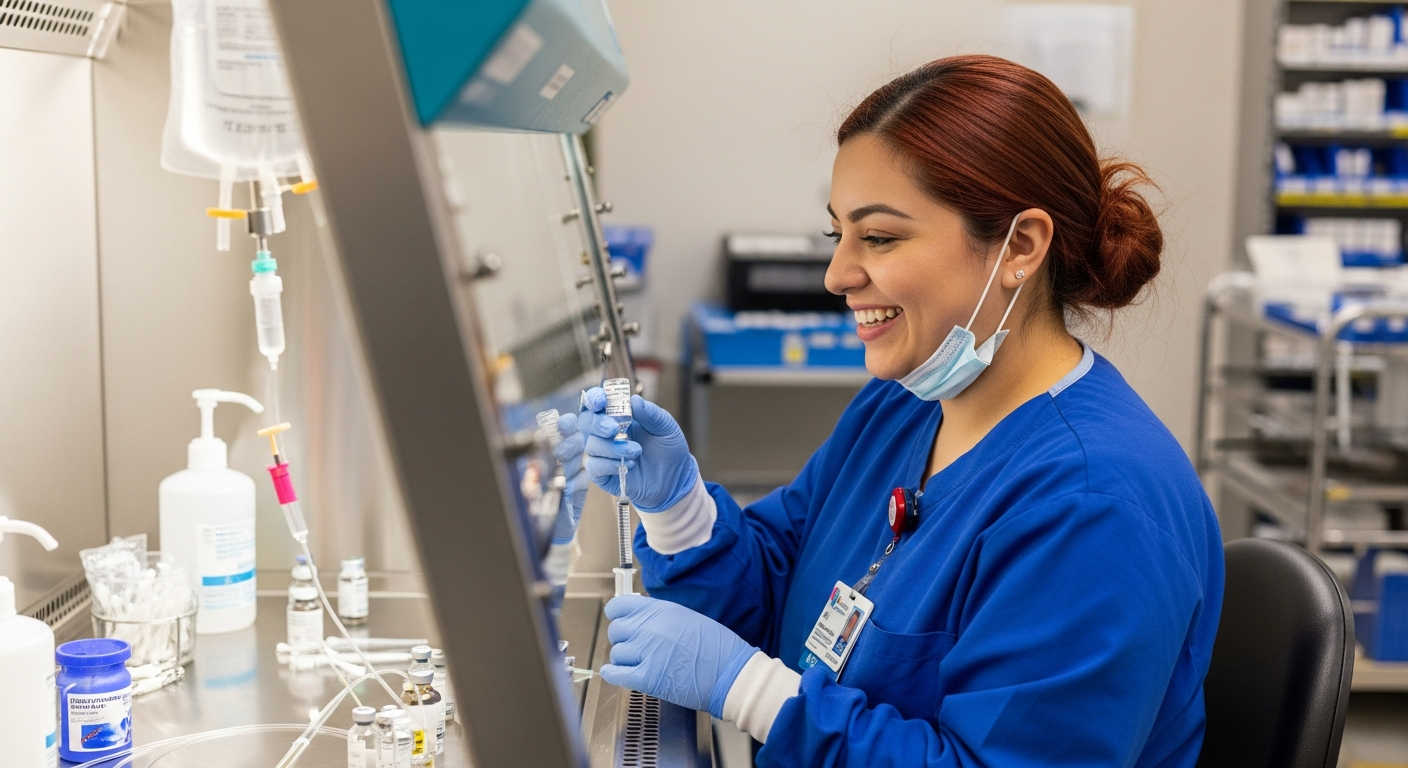
Instead of helping customers at a checkout counter, they may be organizing medication carts for hospital units, managing pharmacy inventory, using automated dispensing systems, or working alongside pharmacists, nurses, and physicians.
That type of role is often called an institutional pharmacy technician.
If you are interested in healthcare but are not sure a retail pharmacy environment is the right fit, it may be worth learning more about what an institutional pharmacy technician does and how the role differs from retail pharmacy work.
What Is an Institutional Pharmacy Technician?
An institutional pharmacy technician works in a healthcare setting, such as:
- Hospitals
- Long-term care facilities
- Rehabilitation centers
- Specialty pharmacies
- Mail-order pharmacies
- Research facilities
These technicians help pharmacists prepare, package, organize, and distribute medications.
In many cases, they are working behind the scenes rather than interacting directly with patients.
For some people, that is part of the appeal.
You are still part of the healthcare team. You are still helping patients receive the right medications safely and on time.
You are just doing it in a different environment.
At Bidwell Training Center’s Institutional Pharmacy Technician program, students learn the specialized skills needed for these healthcare settings, including sterile compounding, pharmacy calculations, medication safety, inventory control, and pharmacy automation.
That means the work often feels a little more technical and process-driven than work in retail pharmacy.
Institutional Pharmacy Technician vs Retail Pharmacy Technician
One of the biggest differences between an institutional pharmacy technician and a retail pharmacy technician is who you interact with each day.
In a retail pharmacy, technicians spend much of their time working directly with customers.
They may answer phones, process payments, enter prescription information, and help patients pick up medications.
Retail pharmacy can be a good fit for people who enjoy customer service, multitasking, and a fast-moving environment.
You are usually interacting with patients all day long, answering questions, ringing up prescriptions, and helping people pick up medications.
Institutional pharmacy feels different.
There is usually less emphasis on customer interaction and more on systems, accuracy, and behind-the-scenes teamwork.
In a hospital or healthcare facility, pharmacy technicians usually work more closely with pharmacists, nurses, and physicians.
Instead of helping patients at the counter, they may be:
- Filling medication carts for hospital floors
- Packaging and labeling medications
- Managing inventory
- Using automated dispensing systems
- Restocking medication cabinets
- Supporting sterile compounding processes
The work tends to be more behind-the-scenes and focused on systems, organization, and precision.
For people who like detail-oriented work, that can be a big draw.
What Skills Does an Institutional Pharmacy Technician Need?
Institutional pharmacy technicians need many of the same core skills as retail pharmacy technicians, but they also have additional technical responsibilities.
For example, institutional pharmacy technicians may need to learn:
- Sterile compounding procedures
- Medication calculations
- Pharmacy law and ethics
- Inventory management
- Pharmacy software systems
- Patient safety procedures
- USP 797 and USP 800 guidelines
Attention to detail matters a lot in this field.
A small error in a dosage calculation or medication label can create serious problems.
That is why institutional pharmacy technicians are trained to follow careful processes and double-check their work.
People who tend to do well in this type of role are often organized, calm under pressure, and comfortable following step-by-step procedures.
What Does a Typical Day Look Like?
A typical day depends on where you work.
In a hospital pharmacy, you might start the morning by helping prepare medications for different patient units.
You may spend part of the day packaging medications, checking inventory, restocking automated dispensing cabinets, or helping make sure medications are delivered to the right floor at the right time.
Later in the day, you could be checking inventory levels, helping restock medication cabinets, or organizing supplies for the pharmacy team.
Some pharmacy technicians spend more time in sterile compounding areas.
Others spend more time managing inventory or helping coordinate medication deliveries across a facility.
There is usually less customer interaction than there is in a retail pharmacy, but there is still a lot of teamwork.
You may spend the day working alongside pharmacists, nurses, lab staff, and other technicians.
That is one reason many people are drawn to institutional pharmacy work. It feels collaborative without being heavily customer-facing.
How Do You Become an Institutional Pharmacy Technician?
The first step is completing training.
At Bidwell Training Center’s Institutional Pharmacy Technician program, students can complete training in as little as 6 months.*
The program includes classroom instruction, hands-on practice, and a 4-week externship.
Students learn how to prepare medications safely, work with pharmacy technology, understand pharmacy law, and navigate the specialized processes used in hospitals and healthcare facilities.
Graduates are also prepared to sit for the Pharmacy Technician Certification Exam (PTCE) through the Pharmacy Technician Certification Board.
Is Institutional Pharmacy a Good Fit for You?
Retail pharmacy and institutional pharmacy are both good career paths. They just appeal to different types of people.
Retail pharmacy may be a better fit if you enjoy talking with customers, answering questions, and working in a more public-facing environment.
Institutional pharmacy may be a better fit if you prefer working behind the scenes, staying organized, and focusing on technical tasks.
A lot of people are surprised by how many options exist within the pharmacy field, and you don’t have to picture yourself standing at a checkout counter forever.
Some pharmacy technicians enjoy the pace of retail. Others find that hospital settings, long-term care facilities, or specialty pharmacies better fit their personalities.
That flexibility is one reason the field appeals to so many career changers.
Final Thoughts
When people first hear the term institutional pharmacy technician, they are often not quite sure what it means. But once they understand the difference, it starts to make sense.
This tends to be a good fit for people who like structure, systems, and detail-oriented work. It can also appeal to people who enjoy being part of a healthcare team but do not necessarily want to spend all day interacting with the public.
It is healthcare, but behind the scenes. You are still helping patients. You are still part of the care team. You are just supporting that process in a different way.
And for the right person, that can be exactly what makes the career such a good fit.
*Program length when completed in normal time.